Ask anyone who has actually done the Mother Road, and you will get the same answer with a smile: the question is not just how long to drive Route 66, but how much of Route 66 you want to feel. On paper, the journey from Chicago to Santa Monica can be measured in miles and driving hours. In real life, it stretches through diner counters, neon signs, red-rock sunsets, trading posts, ghost towns, blues bars, and long desert mornings that make you forget to check the clock.
That is why there is no single perfect number. You can drive Route 66 fast, comfortably, or deeply. Each version gives you a different trip.
How long to drive Route 66 if you want the full experience
If your goal is to enjoy the route rather than simply cover it, 14 to 21 days is the sweet spot.
That range gives you enough time to cross all eight states, stop in the classic towns, take photos without constantly racing daylight, and absorb what makes the road legendary. You can pull over for a restored gas station in Illinois, linger at a roadside cafe in Missouri, stand on a windswept stretch in Texas, and still arrive in California feeling exhilarated instead of wrung out.
For most travelers, two weeks is the practical minimum for a satisfying full Route 66 trip. Three weeks feels richer. You have room for scenic detours, weather changes, slow lunches, museum stops, and those unexpected moments that become the stories you tell for years.
If you try to do it in less than 10 days, the trip starts to feel more like a cross-country transit with a Route 66 backdrop. You will still see famous landmarks, but the road loses some of its character when every day becomes a mileage target.
Route 66 driving time in pure hours
The historic alignment and its many surviving stretches add up to roughly 2,400 miles, depending on how closely you follow old sections, side loops, and town alignments. Pure driving time is often estimated at around 40 to 50 hours.
That sounds manageable until you remember what kind of road this is. Route 66 is not an interstate mindset. It is stop-and-go in places, slower through towns, more scenic, and full of reasons to pull over. A giant muffler man, a classic motel sign, a local bakery, a canyon overlook, a stretch of empty road in Arizona - these are the point.
So yes, technically you can calculate the drive in hours. But nobody dreams of Route 66 so they can stare at a stopwatch.
What changes the answer most
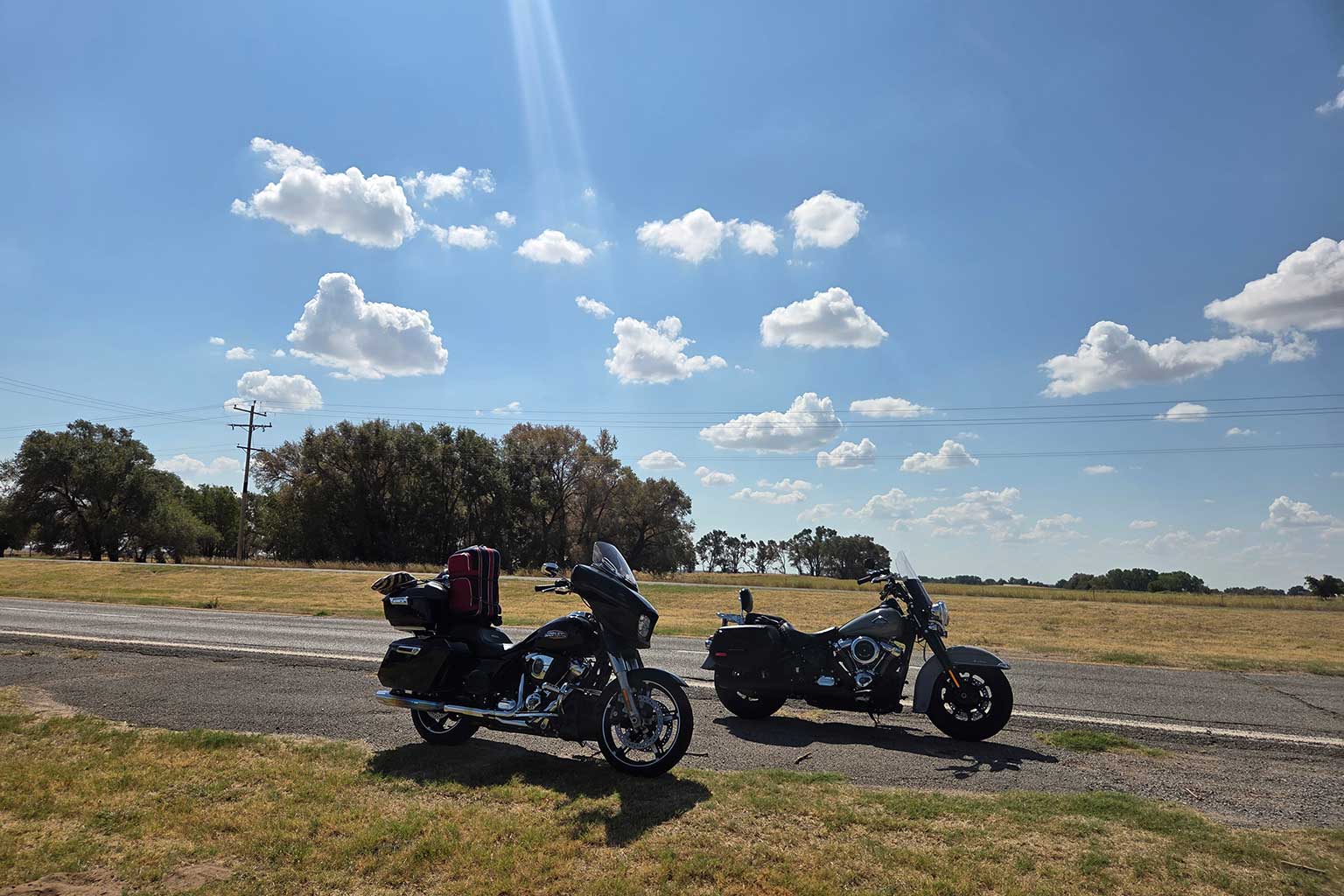
The biggest factor is your travel style. A motorcycle trip often moves differently than a car trip. Riders tend to build in more rest stops, fuel awareness, weather flexibility, and time to enjoy the road itself. Car travelers can cover distance more easily, especially in bad weather or on longer days, but they also tend to stop more often in towns, shops, and roadside attractions because it is simpler to hop in and out.
The second factor is whether you want a highlights trip or a true coast-to-coast journey. Some travelers only have a week and choose a powerful section such as New Mexico and Arizona, where the landscapes feel cinematic and many classic Route 66 icons are still intact. Others want the full emotional arc of starting in Chicago and finishing at the Santa Monica Pier. That full run carries a special weight. It feels earned.
Season matters too. Summer gives you long daylight hours but can bring serious heat in the Southwest. Spring and fall are often more comfortable, though weather can be mixed in the Midwest. If storms, wind, or extreme heat force slower days, your schedule needs breathing room.
The most common Route 66 trip lengths
A 7 to 9 day trip is a fast-paced version. It works best for travelers who know they want the bragging rights and the big landmarks, and who are comfortable with long driving days. You will see a lot, but many stops will be brief, and the rhythm can become tiring by the second half.
A 10 to 14 day trip is where Route 66 starts to open up. You can still keep momentum, but you are not constantly sacrificing charm for speed. This is often the best balance for working adults who want the full route without turning the vacation into an endurance test.
A 15 to 21 day trip is the most rewarding pace for travelers who care about the small towns as much as the famous stops. You can stay in classic motels, talk to local owners, explore short detours, and let each state have its own personality. Illinois feels different from Oklahoma. Arizona feels different from California. With enough time, you notice that.
Anything longer than three weeks becomes a deeper American road trip, which is wonderful if you have the time. You can combine Route 66 with national parks, music history, extra rest days, and longer city stays. At that point, the road becomes part of a larger life experience.
How many hours a day should you drive?
For most people, 3 to 4 hours of actual driving per day feels right on Route 66.
That may sound low for a big cross-country trip, but those hours fill up quickly once you add coffee stops, photo breaks, lunch, fuel, traffic near metro areas, short walks through historic districts, and the simple human desire to not rush every moment. On a motorcycle, that pace is especially comfortable. In a car, you can sometimes push to 4 or 6 hours more easily, but day after day, even that starts to blur the scenery.
The best Route 66 days usually combine meaningful road time with enough margin to enjoy where you land. A sunset in Tucumcari or an evening under neon in Williams is worth far more than another hundred rushed miles.
Why rushing Route 66 can be a mistake
This road rewards attention. If you race it, you collect signs. If you slow down, you collect memories.
One of the quiet truths about Route 66 is that the famous attractions are only half the story. The rest lives in atmosphere. It is the sound of gravel in a motel parking lot, a pie counter at midday, old postcards behind glass, train horns in the distance, and the strange beauty of a nearly forgotten main street still hanging on. None of that fits neatly into a hurry.
Travelers sometimes underestimate fatigue as well. Consecutive long days can flatten the emotional side of the trip. By the time you reach the desert sections that should feel epic, you may simply feel tired. Leaving room in the schedule protects the magic.
If you only have one week
If one week is all you have, you have two honest choices.
The first is to drive the entire route quickly, accepting that this will be a high-mileage journey with selective stops. It can still be thrilling, especially if you have dreamed about crossing America for years and do not mind a demanding pace.
The second, and often better, choice is to focus on one outstanding section. The Southwest is a favorite for good reason. New Mexico and Arizona deliver huge skies, classic roadside architecture, Native American history, desert color, and some of the most photogenic stretches of the whole road. In one week, a regional Route 66 trip can feel fuller and far less rushed than a coast-to-coast sprint.
Guided vs. self-guided timing
How long to drive Route 66 also depends on how much planning you want to do yourself.
A guided motorcycle tour usually keeps the trip efficient without making it feel mechanical. The route, hotels, major stops, and day flow are already organized, so you spend more energy on the experience and less on logistics. That can make a two-week schedule feel surprisingly relaxed because the friction is removed.
A self-guided car tour gives you flexibility and often a bit more privacy, but it also asks more from you each day. Navigation, parking, meal timing, attraction choices, and overnight rhythm all fall on your shoulders. Some travelers love that freedom. Others discover that even a dream road trip feels smoother when the bones of the itinerary are already built. That is one reason Route 66 Tours INC has spent years shaping trips that protect both the romance and the practical side of the road.
The best answer for most travelers
If you want the full Route 66 journey and do not want to shortchange it, plan for about 14 days. If you can give it 18 to 21 days, even better.
That window gives the road room to breathe. It lets Chicago feel like a true beginning and Santa Monica feel like a real finish. It allows for weather, wonder, and the occasional change of plan that turns a good road trip into an unforgettable one.
Route 66 is one of those rare journeys where the clock matters, but not as much as the pace. Give yourself enough days to notice where you are, and the road will give something back.